“The soul that sinneth must die” says the natural law as recorded in the bible. Taken by its literal meaning, this means that anyone who kills another must be killed. The right to life is a fundamental right to which everyone is entitled and this right is so revered that Section 33 (1) of the constitution of the Federal Republic of Nigeria 1999 (hereafter referred to as CFRN) copiously provides for the protection of this right to the extent that no one is allowed to take another’s life.
Section 33(2) of the constitution provides three conditions under which a person killed by another may be said to have been deprived of his right to life in contravention of S.33 (1). Similarly, section 32 of the Criminal Code Cap “C38” Laws of the Federation of Nigeria, 2004, equally excuses a person from criminal liability who has killed another person.
By virtue of
the foregoing, immediate emphasis need be made on the fact that certain
defneces can be averred by a person who has killed another so that such murder
may become justified or “legal”, not because the act is right but because of
the circumstances of the act.
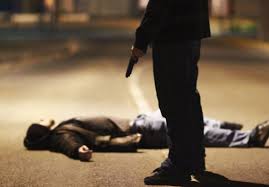
One of such
defences is Self Defence. Where death results when a person is in an attempts
to protect himself, his property or another person(’s) (known in theAmerican
jurisdiction as - alter ego defence of others) from being unlawfully harmed, such
murder is by the law regarded as legal. This is copiously provided for in
section 32(3) and (4) of the Criminal Code.
*Self
defence is however not provided to protect people from criminality. Put
differently, anyone seeking to rely on this defence must have acted in good
faith. This is why section 33(4) concludes with the caveat that the section
does not operate to protect anyone from an act or omission punishable with
death.

Furthermore, the act does not protect anyone
who having entered into an unlawful association or conspiracy where threats to
life could be made to him, kills another in the course of protecting himself or
another who must have joined the same association with him from such threatened
harm. This is obviously because by being a part of such clandestine
association, he has volunteered himself to assume any such threat which may be
a natural consequence of belonging to such unlawful association and in lawvolenti
non fit injuria meaning that a person who willingly assumes a risk is
assumed to have submitted to the situation he finds himself and thus cannot
complain about the consequence of such assumed risk.
It must not escape
mention however, that any act done in self defence must not be manifestly
unlawful.In other words, where a person attempts to respond to a threatened
violence, he must do so with a reasonable exercise of caution. The defensive
act must for instance be commensurate with the threatened violence. Therefore,
where a person uses a force which is not proportional with the threatened
violence, the defence of self defence will not avail him.More so, where the
victim is weaker than his assailant, self defence will fail to protect the
later from conviction
.
.
What this means is that where a person such as a law
enforcement agent kills another while doing his lawful duty or while obeying a
superior authority, he will not be held criminally responsible for murder. It
must be noted however that for a person to successfully rely on having
obeyed a superior order, such order must not be illegal.
Similarly,
section 33 (2) (c) of CFRN further provides to the effect that a person will
not be held criminally responsible for killing another in the course of an act
done in order to quell a riot, insurrection or mutiny.
Evidently
from the foregoing, not everyone who kills gets killed. Aside the fore stated
protections, several other defences could work to exculpate a person who kills
another from liability. Some of these include Insanity, Accident, Automatism,
Insane Delusion, Intoxication, Provocation etc.
It must be stressed at this point that all these defences are premised on the express provision of S.24 of the Criminal Code provides a person in not criminally responsible for an act or omission, which occurs independently of the exercise of his will or for an act which occurs by accident.
Thus, a person will not be said to have committed an offence which he did not pre-conceive in his mind. In other words, a person is only guilty of an offence which he had the intention to commit.
It must be stressed at this point that all these defences are premised on the express provision of S.24 of the Criminal Code provides a person in not criminally responsible for an act or omission, which occurs independently of the exercise of his will or for an act which occurs by accident.
Thus, a person will not be said to have committed an offence which he did not pre-conceive in his mind. In other words, a person is only guilty of an offence which he had the intention to commit.
For a person who is under the influence of
alcohol for instance, he is assumed to have lost the ability to know what he is
doing at the time or to understand the consequence of such act. Thus, he does
not have the ability to form the requisite mens
rea (mental element) to commit an offence. It must be pointed out however
that intoxication will fail to protect who willingly places himself under the
influence of alcohol.
This exception contained in section 29(2)(a) of the Criminal Code is so as to prevent a person from deliberately inducing himself with alcohol in order to acquire Dutch Courage to commit a crime, in which case the defence of intoxication will fail to protect him.

This exception contained in section 29(2)(a) of the Criminal Code is so as to prevent a person from deliberately inducing himself with alcohol in order to acquire Dutch Courage to commit a crime, in which case the defence of intoxication will fail to protect him.
Obviosusly,
these defences where successfully pleaded in cuourt, operates to set the
accused free from being killed. It is the prosecutor’s
duty to prove that the accused had the mens rea to commit the alleged crime and
that he actually committed the crime. Where for any reason, the prosecutor
fails to do this, the case will be resolved in the favor of the accused.
WRITTEN BY: STANLEY A. NNABUO.